
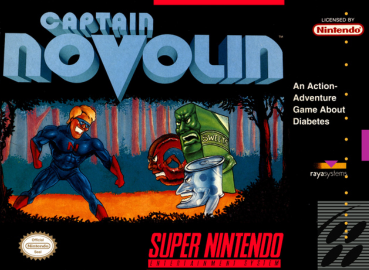
When brands launch their own games, sell in-game items or build entire metaverses today, it seems like a modern phenomenon. But the connection between marketing and video games was already being used quite cleverly over 30 years ago. A nice (and slightly absurd) example of this is Captain Novolin.
A superhero fighting against sugar
Captain Novolin was released in 1992 for the Super Nintendo Entertainment System (SNES). The game was developed by Sculptured Software on behalf of Novo Nordisk, a Danish pharmaceutical company specialising in diabetes products.
The story is simple and wonderfully 90s:
Superhero Captain Novolin fights the villain Krozar, who spreads sugar across the world, making people sick. The aim of the game is to avoid sugar, collect healthy foods and ultimately defeat the antagonist.
Today, it sounds like an indie ‘edutainment’ game – but back then, it was something completely different.
An advertising game that didn’t want to be one
Captain Novolin was essentially an advergame, even though the term was hardly used at the time. Interestingly, the game was not sold on the open market, but was mainly distributed through doctors, diabetes counselling centres and specialist agencies. The target audience was children with diabetes – and their parents.
Marketing approach:
- Education instead of sales
- Playful knowledge transfer
- Emotional connection to a difficult topic
Novo Nordisk did not clumsily advertise insulin here, but positioned itself as an understanding, supportive brand. Exactly what we would call ‘brand purpose’ today.
How marketing and games worked back then
In the early 90s, gaming was not yet a mass medium as it is today, but:
- Consoles were already in many children’s bedrooms
- Games were considered intense, emotional and time-consuming
- Interactive media were significantly more effective than brochures.
Captain Novolin took advantage of precisely that:
- Gamification, long before the word existed.
- Storytelling to make a medical topic tangible.
- Role models instead of finger-wagging.
The game wasn’t particularly good (objectively speaking, it was actually quite difficult and clunky), but it stuck in people’s minds. And that’s exactly what marketing is all about.
Why Captain Novolin was ahead of its time
Today we see:
- Nike Games in Roblox
- Red Bull as a gaming lifestyle brand
- Health insurance companies with fitness apps and challenges
Captain Novolin was basically all of that – only in 16-bit.
Even back then, the game showed that:
Brands can be part of a living environment
Games are perfect for conveying complex topics emotionally
Good brand communication doesn’t have to sell, it has to be relevant
Pixels, Purpose and a Little Sugar
Captain Novolin is not a forgotten SNES masterpiece, but an exciting historical document. It shows that the idea behind modern game marketing is not new at all – only the technology and reach have changed.
Image source: Wikipedia